
Introduction
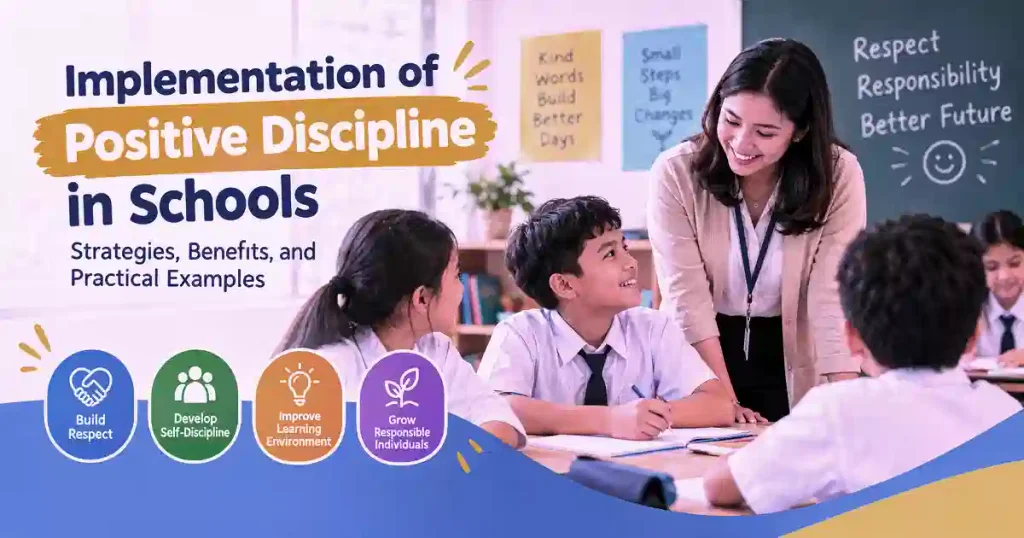
Creating a safe, respectful, and supportive learning environment is one of the most important responsibilities of every school. However, maintaining student discipline can be challenging when teachers encounter disruptive behavior, conflicts among classmates, low motivation, or difficulties following classroom rules.
One effective approach to addressing these challenges is positive discipline in schools. Rather than relying on fear, threats, humiliation, or harsh punishment, positive discipline helps students understand their behavior, recognize its consequences, develop self-control, and take responsibility for their actions.
Positive discipline does not mean allowing students to do whatever they want. Instead, it combines clear expectations, consistent boundaries, respectful communication, and appropriate consequences to help students learn from their mistakes.
According to UNESCO’s guide on positive discipline, teachers can use proactive and nonviolent strategies to prevent misbehavior, respond constructively to challenges, and create inclusive, learning-friendly classrooms.
By implementing positive discipline consistently, schools can foster a culture in which students feel valued, understand their responsibilities, and develop the social and emotional skills necessary for lifelong learning.
1. What Is Positive Discipline in Schools?
Positive discipline in schools is an educational approach that guides students toward responsible behavior through mutual respect, clear expectations, constructive feedback, and meaningful learning experiences.
The primary purpose is not simply to stop inappropriate behavior but to help students understand why certain behaviors are harmful and how they can make better choices in the future.
For example, when a student repeatedly interrupts a lesson, a teacher using traditional punitive discipline might immediately shout at the student or impose a harsh penalty. A teacher applying positive discipline would calmly explain the impact of the behavior, remind the student of the classroom agreement, and help the student identify a more appropriate way to participate.
Positive discipline emphasizes three important principles:
- Respect: Every student deserves dignity, fairness, and protection from violence and humiliation.
- Responsibility: Students should understand how their choices affect themselves and others.
- Learning: Mistakes and inappropriate behavior should become opportunities to develop better habits and decision-making skills.
Positive discipline therefore combines kindness with firmness. Teachers remain responsible for maintaining order, but they use their authority to guide and educate rather than intimidate students.
2. Why Is Positive Discipline Important in Schools?
Positive discipline contributes to a learning environment where students can develop academically, socially, and emotionally.
A. Creating a Safe and Supportive Learning Environment
Students are more likely to participate in learning when they feel respected and protected. Positive discipline encourages teachers to address inappropriate behavior without creating unnecessary fear or embarrassment.
A safe classroom allows students to ask questions, express opinions, make mistakes, and learn from feedback.
B. Developing Self-Discipline
Students need opportunities to learn how to manage their emotions, control impulses, and make responsible decisions.
Instead of depending entirely on external punishment, positive discipline encourages students to understand the reasons behind classroom rules and gradually develop internal motivation to follow them.
C. Strengthening Teacher-Student Relationships
Respectful communication builds trust between teachers and students. When students believe that their teachers care about their well-being, they may be more willing to seek help, accept feedback, and correct their behavior.
The Centers for Disease Control and Prevention (CDC) identifies caring teacher-student relationships, clear expectations, student autonomy, and positive behavior management as important approaches to strengthening school connectedness.
D. Encouraging Social and Emotional Learning
Positive discipline supports the development of essential social and emotional competencies, including:
- Self-awareness and emotional regulation.
- Empathy and respect for others.
- Responsible decision-making.
- Conflict resolution.
- Cooperation and communication.
These skills help students manage disagreements and build healthier relationships with classmates.
E. Reducing Repeated Behavioral Problems
When teachers identify the reasons behind inappropriate behavior and teach suitable alternatives, students have a better opportunity to change their behavior.
Consistent expectations, timely feedback, and appropriate corrective consequences can help reduce classroom disruptions and protect valuable learning time.
3. Key Principles of Implementing Positive Discipline
Successful implementation requires more than changing the way teachers respond to misbehavior. It involves developing a consistent approach to relationships, expectations, and student responsibility.
A. Establish Clear and Consistent Rules
Classroom rules should be simple, understandable, realistic, and appropriate for students’ ages and developmental needs.
Whenever possible, involve students in creating classroom agreements. This participatory process helps them understand the purpose of the rules and develop a sense of ownership.
Examples of classroom agreements include:
- Listen respectfully when someone is speaking.
- Arrive on time and prepare learning materials.
- Keep the classroom clean and organized.
- Use respectful language when expressing disagreement.
- Complete assigned responsibilities.
- Resolve conflicts without violence.
Display the agreements in a visible location and review them regularly.
B. Build Positive Relationships with Students
Teachers should make an effort to understand students as individuals, including their interests, strengths, challenges, and learning needs.
Simple practices can make a difference, such as greeting students, listening attentively, acknowledging their efforts, and providing constructive feedback.
A positive relationship does not eliminate boundaries. Instead, it creates a foundation for addressing behavioral concerns fairly and respectfully.
C. Focus on Teaching Appropriate Behavior
Students should not automatically be expected to know how to behave in every classroom situation. Teachers need to explain, model, and practice expected behaviors with them.
For instance, teachers can demonstrate how to take turns during a discussion, ask for help appropriately, work collaboratively, and disagree without insulting others.
When students struggle, reteach the expected behavior rather than assuming that punishment alone will solve the problem.
D. Use Logical and Educational Consequences
Consequences should be related to the behavior, proportionate to the situation, and designed to help students learn.
For example, a student who deliberately leaves learning materials scattered around the classroom can be asked to help restore the area.
A student who damages another student’s work may need to acknowledge the harm, apologize appropriately, and help repair or replace the damaged work where possible.
Logical consequences differ from punishment because their main purpose is to encourage understanding, accountability, and improvement.
E. Treat Students Fairly and Respect Individual Differences
Fairness does not always mean responding to every student in exactly the same way. Students may have different developmental stages, learning needs, communication styles, and personal circumstances.
Teachers should apply classroom expectations consistently while considering relevant individual needs and providing reasonable support.
Positive discipline must never be used to label students as bad, lazy, or difficult. It should focus on observable behavior and the skills students need to develop.
4. Practical Strategies for Implementing Positive Discipline in the Classroom
The following strategies can be adapted for elementary, junior secondary, and senior secondary schools.
A. Use Positive Reinforcement
Positive reinforcement involves acknowledging desirable behavior so students understand which actions contribute to a successful learning environment.
Examples include:
- Praising a student for helping a classmate.
- Recognizing improvement in punctuality.
- Acknowledging respectful participation in discussions.
- Providing specific feedback when a student manages frustration appropriately.
Effective praise should be sincere and specific.
Instead of saying, “You are the best student,” a teacher might say, “You listened carefully to your classmates and waited for your turn to speak. That helped everyone participate.”
This approach emphasizes the behavior and effort rather than comparing students.
B. Apply Restorative Practices
Restorative practices help students understand the impact of their actions and take steps to repair harm.
When a conflict occurs, teachers can ask questions such as:
- What happened?
- What were you thinking or feeling at the time?
- Who was affected by what happened?
- What can you do to make things right?
- What could you do differently next time?
For example, if a student makes an insulting comment to a classmate, the teacher can guide the student to recognize the impact of the comment and identify a meaningful way to repair the relationship.
Restorative conversations should be conducted calmly and safely. They should not force students who have experienced harm to participate in a confrontation or accept an apology before they are ready.
C. Teach Emotional Regulation
Students sometimes behave inappropriately because they have difficulty recognizing or managing strong emotions.
Teachers can help by teaching students to:
- Recognize what they are feeling.
- Pause before reacting.
- Use breathing or other calming strategies.
- Explain their feelings respectfully.
- Choose an appropriate response.
A classroom can also provide a designated quiet area where students may briefly regulate their emotions under clear supervision and agreed procedures.
This space should not become a place of humiliation or exclusion.
D. Use Calm and Respectful Communication
The teacher’s response can influence whether a difficult situation becomes more serious or begins to improve.
When addressing inappropriate behavior, teachers should use a calm voice, concise instructions, and language that focuses on the action rather than attacking the student’s character.
For example:
Instead of saying, “You are always disturbing the class,” a teacher could say, “You are talking while your classmates are working. Please lower your voice so everyone can concentrate.”
The second statement identifies the behavior, explains the expectation, and provides a clear direction.
E. Provide Meaningful Student Choices
Giving students appropriate choices can encourage autonomy and responsibility.
For example, a teacher might allow a student to choose whether to complete an individual reflection before or after a short classroom task, provided both options meet the learning objective.
Choices should remain within reasonable boundaries. Students may choose how to meet an expectation, but they should not be allowed to harm others or disregard essential safety rules.
F. Communicate with Parents and Guardians
Positive discipline becomes more effective when teachers and families communicate constructively.
Schools can share classroom expectations, discuss student progress, and work with families to identify appropriate strategies for recurring behavioral challenges.
Communication should focus on specific observations, possible contributing factors, and practical next steps rather than blaming students or their families.
Where necessary, teachers can collaborate with school counselors, student support teams, or other qualified professionals.
5. Examples of Positive Discipline in Everyday School Situations
The following examples illustrate how positive discipline can be applied in practice.
| Student behavior | Positive discipline response | Intended learning outcome |
|---|---|---|
| Arriving late to class | Discuss the reason, review expectations, and agree on a practical improvement plan. | Punctuality and responsibility |
| Interrupting the teacher | Calmly remind the student of discussion rules and provide an appropriate opportunity to contribute. | Self-control and respectful communication |
| Bullying or insulting a classmate | Protect the affected student, address the behavior, establish appropriate consequences, and plan follow-up support. | Accountability, empathy, and safety |
| Leaving the classroom untidy | Ask the student to help restore the learning environment. | Responsibility and care for shared spaces |
| Failing to complete assignments | Identify barriers, clarify expectations, and agree on a realistic completion plan. | Organization and persistence |
| Arguing during group work | Guide students to listen, explain their perspectives, and agree on a fair way to continue. | Cooperation and conflict resolution |
These responses should be adapted to the seriousness of the behavior, the student’s needs, and the school’s safeguarding and disciplinary policies.
Serious misconduct, violence, or bullying may require formal intervention, additional supervision, family involvement, and protection measures. Positive discipline does not mean ignoring harm or removing appropriate consequences.
6. How Schools Can Implement Positive Discipline Systematically
Positive discipline is most effective when it becomes part of the school’s overall culture rather than an approach used by only a few teachers.
Step 1: Review Existing Discipline Policies
School leaders should examine current rules and disciplinary procedures to identify practices that rely on humiliation, intimidation, or disproportionate punishment.
Policies should clearly explain acceptable behavior, reporting procedures, appropriate consequences, and safeguards for students.
Step 2: Provide Teacher Training
Teachers need practical skills in classroom management, respectful communication, conflict resolution, emotional regulation, and restorative conversations.
Professional development can include workshops, classroom simulations, peer observation, and collaborative reflection.
Step 3: Develop Schoolwide Expectations
Teachers and school leaders should agree on a small set of shared behavioral expectations.
For example, the school may emphasize respect, responsibility, safety, honesty, and cooperation.
Consistent expectations help students understand that the same core values apply across classrooms and school activities.
Step 4: Involve Students and Families
Students should have opportunities to discuss classroom agreements and suggest ways to improve the school environment.
Families can contribute through meetings, constructive communication, and cooperation with teachers when behavioral concerns arise.
Step 5: Monitor Progress and Make Improvements
Schools should periodically review whether positive discipline is helping students and teachers.
Possible indicators include:
- Changes in classroom disruptions.
- Student attendance and punctuality.
- Reports of bullying and conflict.
- Student perceptions of safety and belonging.
- Teacher observations of student behavior.
- Feedback from parents and guardians.
Schools should use these indicators to identify what is working and where further support is needed. Improvements should be evaluated over time rather than assumed to occur immediately.
7. Challenges in Implementing Positive Discipline and How to Address Them
Although positive discipline offers important educational benefits, its implementation can face several challenges.
A. Resistance to Changing Traditional Practices
Some teachers may believe that strict punishment is necessary to maintain authority.
Schools can address this concern through professional development, practical demonstrations, peer mentoring, and clear explanations that positive discipline combines respect with consistent boundaries.
B. Limited Time and Large Class Sizes
Teachers managing large classes may find individual conversations difficult.
Practical solutions include establishing classroom routines, teaching expectations explicitly, using peer cooperation, and addressing minor problems with brief, calm reminders.
More serious or recurring concerns may require scheduled follow-up rather than lengthy discussions during lessons.
C. Inconsistent Responses Among Teachers
Students may become confused when similar behaviors receive very different responses across classrooms.
School leaders should establish shared expectations and provide opportunities for teachers to discuss cases, review procedures, and improve consistency while allowing reasonable flexibility for individual circumstances.
D. Misunderstanding Positive Discipline as Permissiveness
Positive discipline does not mean that students face no consequences.
Teachers should communicate expectations clearly, respond promptly to harmful behavior, and apply proportionate consequences that support learning, accountability, and safety.
E. Limited Family Involvement
Some families may have different expectations about discipline or limited time to communicate with schools.
Teachers can help by using accessible communication methods, providing specific examples of student behavior, and inviting families to collaborate on realistic solutions.
8. The Role of School Leaders in Supporting Positive Discipline
School leaders play a central role in ensuring that positive discipline is implemented consistently and sustainably.
Their responsibilities include:
- Developing clear, fair, and student-centered discipline policies.
- Ensuring that school practices protect students from violence and humiliation.
- Providing teachers with training and professional support.
- Encouraging collaboration among teachers, counselors, students, and families.
- Establishing procedures for reporting bullying, violence, and other safeguarding concerns.
- Monitoring school climate and responding to evidence of recurring problems.
School leaders should also model respectful communication in their interactions with teachers, students, and families.
When the entire school community demonstrates fairness, accountability, and respect, positive discipline becomes a shared responsibility.
9. Conclusion
The implementation of positive discipline in schools is an important step toward creating a safe, inclusive, and effective learning environment.
By establishing clear classroom agreements, building positive relationships, teaching appropriate behavior, using logical consequences, and applying restorative practices, teachers can help students develop self-discipline and responsibility.
Positive discipline does not eliminate the need for rules or consequences. Instead, it makes discipline more educational by helping students understand the effects of their actions and learn how to make better decisions.
Successful implementation requires cooperation among teachers, school leaders, students, and families. With consistent support and regular evaluation, schools can build a culture in which discipline strengthens learning, relationships, and character development.
Ultimately, the goal of positive discipline is not merely to make students obey rules, but to help them become responsible individuals who can regulate their behavior, respect others, and contribute positively to their communities.
Frequently Asked Questions (FAQ)
1. What is positive discipline in schools?
Positive discipline is an educational approach that teaches students responsible behavior through respectful communication, clear expectations, constructive feedback, and appropriate consequences rather than fear or humiliation.
2. What are the main benefits of positive discipline?
Positive discipline can support self-control, responsible decision-making, positive teacher-student relationships, social and emotional development, and a safer classroom environment.
3. Does positive discipline mean that students are never punished?
No. Positive discipline includes appropriate consequences for harmful or inappropriate behavior. The difference is that consequences should be fair, proportionate, educational, and focused on accountability and improvement.
4. How can teachers implement positive discipline in the classroom?
Teachers can establish clear classroom agreements, model expected behavior, reinforce positive actions, communicate calmly, teach emotional regulation, and use restorative conversations when conflicts occur.
5. How does positive discipline differ from traditional punishment?
Traditional punishment often emphasizes penalties or immediate compliance. Positive discipline emphasizes teaching, accountability, self-regulation, and helping students understand the impact of their behavior while maintaining appropriate boundaries.
6. Can positive discipline be applied to all age groups?
Yes. Its principles can be adapted to different developmental stages. Younger students may benefit from simple rules and visual reminders, while older students can participate in discussions, reflection, and collaborative problem-solving.
7. How can schools deal with repeated misbehavior?
Schools should identify patterns and possible contributing factors, communicate with the student, teach alternative behaviors, apply consistent consequences, and collaborate with families and support professionals when necessary.
8. What is the role of parents in positive discipline?
Parents can reinforce respectful behavior, communicate with teachers, establish consistent expectations at home, and work with schools to help children develop responsibility and self-control.
9. Is positive discipline effective in preventing bullying?
Positive discipline can contribute to a respectful school culture and support early intervention. However, bullying requires a specific response that prioritizes the safety of affected students, investigates concerns appropriately, and implements suitable protective and corrective measures.
10. How can schools measure the success of positive discipline?
Schools can monitor behavioral incidents, attendance, punctuality, student perceptions of safety, classroom engagement, and feedback from teachers and families. Reviewing these indicators over time helps schools identify progress and areas requiring further support.
References
- UNESCO. (2014). Positive Discipline in the Inclusive, Learning-Friendly Classroom: A Guide for Teachers and Teacher Educators.
https://unesdoc.unesco.org/in/rest/annotationSVC/DownloadWatermarkedAttachment/attach_import_aaec4d7a-41cd-4bb8-9d1b-03efb1aa98a2?_=149284eng.pdf - Centers for Disease Control and Prevention (CDC). (2024). Behavior Management.
https://www.cdc.gov/classroom-management/approaches/behavior-management.html - Centers for Disease Control and Prevention (CDC). (2025). Promoting School Connectedness Through Restorative Practices.
https://www.cdc.gov/youth-behavior/school-connectedness/restorative-practices.html - Institute of Education Sciences (IES), What Works Clearinghouse. (2024). Teacher-Delivered Behavioral Interventions in Grades K–5.
https://ies.ed.gov/ncee/WWC/PracticeGuide/31 - UNICEF. Education Kit Handbook. Guidance on positive discipline, student self-control, respect, and collaborative learning environments.
https://www.unicef.org/supply/media/661/file/guidelines-for-training-of-trainers-education-UNICEF-kit-handbook.pdf
These references provide further guidance for educators who want to strengthen classroom management, promote positive student behavior, and create safe and inclusive learning environments.