
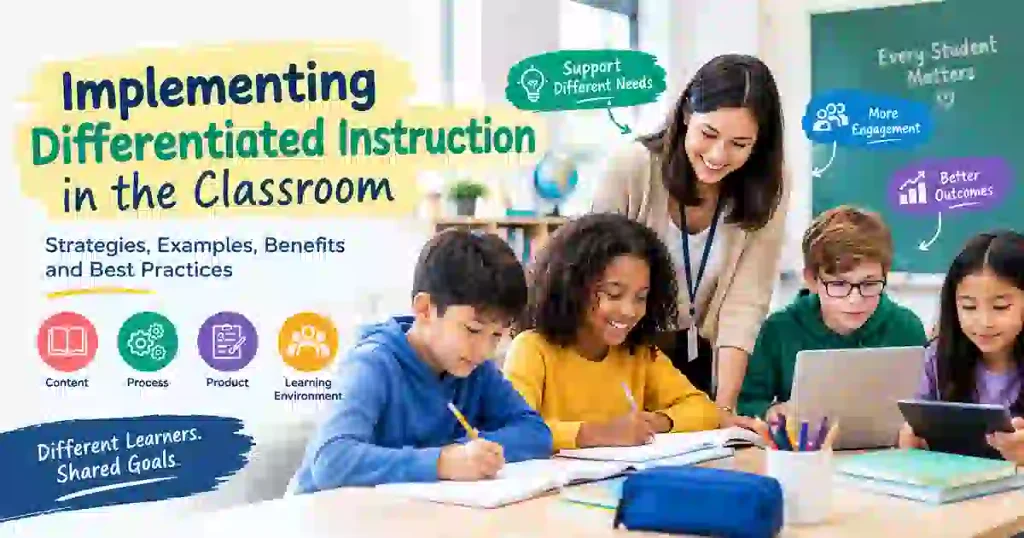
Every student has unique learning needs, interests, abilities, and learning experiences. In a single classroom, some students may understand a concept quickly, while others need additional explanations, visual aids, or hands-on activities. These differences present an important challenge for teachers: how can they ensure that every student has a meaningful opportunity to learn?
Differentiated instruction is an educational approach that helps teachers address students’ diverse learning needs by adapting teaching methods, learning activities, materials, and assessments. Rather than expecting every student to learn in exactly the same way, differentiated instruction provides flexible pathways toward shared learning goals.
Implementing differentiated instruction in the classroom can create a more inclusive, engaging, and effective learning environment. This article explores its meaning, principles, benefits, practical strategies, and examples that teachers can apply in everyday teaching.
What Is Differentiated Instruction?
Differentiated instruction is a teaching approach in which educators proactively adjust instruction to respond to differences in students’ readiness levels, interests, and learning needs.
According to Carol Ann Tomlinson, a leading scholar in differentiated instruction, teachers can differentiate instruction through the content students learn, the process they use to learn, the products they create to demonstrate understanding, and the learning environment in which instruction takes place.
The primary purpose is not to create an entirely different curriculum for every student. Instead, teachers maintain meaningful learning objectives while providing appropriate support, challenges, and opportunities for students to achieve those objectives.
For example, when teaching a reading comprehension lesson, a teacher might provide different levels of reading materials, organize flexible discussion groups, and allow students to demonstrate understanding through written responses, oral presentations, or visual representations.
Although the activities may differ, all students work toward the same essential learning goals.
Why Is Differentiated Instruction Important?
Students enter the classroom with different levels of prior knowledge, language abilities, interests, learning experiences, and confidence. A single teaching method may not adequately address all these differences.
Differentiated instruction helps teachers respond to this diversity without lowering expectations or excluding students from meaningful learning experiences.
Several factors make differentiated instruction important in modern education.
A. Recognizing Individual Learning Needs
Students do not all learn at the same pace. Some may require additional practice, while others benefit from more complex tasks.
Differentiated instruction enables teachers to identify these differences and provide appropriate learning opportunities.
B. Increasing Student Engagement
Students are more likely to participate actively when learning activities connect with their interests, experiences, and abilities.
Offering meaningful choices can encourage curiosity, motivation, and classroom participation.
C. Supporting Inclusive Education
An inclusive classroom recognizes that differences among students are normal. Teachers can provide scaffolding, accessible materials, additional explanations, and enrichment activities so that more students can participate successfully.
D. Encouraging Independent Learning
When students understand their learning goals and receive appropriate support, they can gradually develop responsibility for their progress.
They learn to recognize their strengths, identify areas for improvement, and make informed decisions about how to approach learning tasks.
The Main Elements of Differentiated Instruction
Differentiated instruction commonly involves four interconnected elements: content, process, product, and learning environment.
A. Differentiating Content
Content refers to what students learn, including concepts, information, skills, and learning resources.
Teachers may differentiate content by providing texts at different reading levels, using visual explanations, offering audio materials, or supplying additional resources for students who need enrichment.
For example, in a science lesson about ecosystems, some students may use illustrated reading materials, while others explore more detailed scientific texts. Both groups study the same essential concepts.
B. Differentiating Process
Process refers to how students engage with and make sense of learning content.
Teachers can vary learning activities through individual work, collaborative projects, guided practice, experiments, discussions, and problem-solving tasks.
For instance, students learning mathematical fractions might use fraction models, solve problems with teacher guidance, or investigate more challenging real-world applications.
C. Differentiating Product
Product refers to how students demonstrate what they have learned.
Depending on the learning objectives, teachers may allow students to prepare written reports, presentations, diagrams, models, or recorded explanations.
The assessment criteria should remain aligned with the intended learning outcomes, even when students use different ways to demonstrate their understanding.
D. Differentiating the Learning Environment
The learning environment includes the physical, social, and emotional conditions in which students learn.
Teachers can establish quiet work areas, collaborative spaces, clear classroom routines, and supportive discussion practices. They can also build a classroom culture in which students feel safe asking questions, making mistakes, and seeking assistance.
A supportive environment helps students participate without fear of embarrassment or unnecessary comparison.
Practical Strategies for Implementing Differentiated Instruction
Differentiated instruction becomes most effective when it is integrated into lesson planning and daily classroom practice. Teachers do not need to redesign every lesson completely. Small, intentional adjustments can make a meaningful difference.
A. Assess Students’ Readiness Before Teaching
Before introducing a topic, teachers should identify what students already know and what they still need to learn.
This can be accomplished through diagnostic questions, short quizzes, classroom discussions, observation, concept maps, or brief written tasks.
The results help teachers determine whether students need foundational instruction, additional practice, or more advanced challenges.
Assessment should be used to guide teaching decisions rather than simply label students according to ability.
B. Use Flexible Grouping
Flexible grouping allows teachers to organize students in different ways according to the learning objective and the task.
Students may work individually, in pairs, in mixed-ability groups, or in temporary groups with similar learning needs.
For example, a teacher might organize a small group for additional guidance while other students complete independent activities or extension tasks.
Groups should change when students’ needs change. Students should not be permanently assigned to a group based on a fixed judgment of their ability.
C. Provide Different Levels of Support
Scaffolding helps students complete tasks that they may not yet be able to manage independently.
Teachers can provide sentence starters, graphic organizers, worked examples, vocabulary lists, guiding questions, visual aids, and step-by-step instructions.
As students gain confidence and competence, teachers can gradually reduce these supports.
Students who are ready for greater complexity can receive open-ended questions, independent investigations, or more demanding applications of the same concepts.
D. Offer Meaningful Learning Choices
Giving students some choice can increase ownership and engagement.
For example, after studying a historical event, students might choose to write an analytical essay, create a timeline, or deliver an oral presentation.
However, choice should not replace clear learning objectives. Each option must provide a valid opportunity to demonstrate the required knowledge and skills.
E. Use Varied Teaching Resources
Teachers can combine textbooks, videos, diagrams, physical objects, digital resources, experiments, and real-world examples.
Multiple representations help make concepts accessible to students with different levels of prior knowledge and different learning needs.
Technology can support differentiation through interactive exercises, accessible digital texts, learning management systems, and practice activities that respond to student performance.
Nevertheless, digital tools should support sound teaching decisions rather than become an end in themselves.
F. Apply Ongoing Formative Assessment
Formative assessment helps teachers understand student progress while learning is taking place.
Examples include exit tickets, observation checklists, questioning, short quizzes, peer feedback, and student reflections.
Teachers can use this information to adjust explanations, provide additional practice, modify groups, or introduce enrichment activities.
Effective differentiation is an ongoing process: assess, plan, teach, observe, and adjust.
Examples of Differentiated Instruction Across Subjects
The following examples illustrate how differentiated instruction can be applied in different classroom settings.
A. English Language Learning
During a lesson on descriptive writing, students may receive different levels of support.
Students who need additional guidance can use vocabulary banks, sentence frames, and model paragraphs. Students who are more confident can develop detailed descriptions using figurative language and varied sentence structures.
All students work toward the goal of producing clear, descriptive writing.
B. Mathematics
In a lesson on fractions, the teacher may prepare three types of activities.
- Foundational practice: Students use visual fraction models and guided examples.
- Core practice: Students solve fraction problems independently and explain their reasoning.
- Extension activities: Students solve multistep problems involving fractions in real-life situations.
The teacher monitors student progress and adjusts activities as needed.
C. Science
When studying plant growth, students may investigate the same scientific question through different methods.
Some students may follow a structured experiment with detailed instructions. Others may design their own investigation, record variables, and explain the results using scientific evidence.
The teacher evaluates students according to the scientific skills and concepts specified in the lesson objectives.
D. Social Studies
During a lesson on local history, students may examine photographs, short texts, maps, interviews, or historical documents.
They can demonstrate their understanding through a written explanation, a visual timeline, or an oral presentation. Each product should address the same essential historical questions.
These examples demonstrate that differentiation is possible in different subjects without requiring a completely separate curriculum for each student.
A Step-by-Step Guide to Planning a Differentiated Lesson
Teachers can use the following sequence to integrate differentiated instruction into their lesson plans.
Step 1: Define the learning objectives.
Identify the essential knowledge, skills, or competencies that all students are expected to develop.
Step 2: Identify students’ learning needs.
Use prior assessment results, observations, student work, and classroom discussions to understand students’ starting points.
Step 3: Plan flexible learning activities.
Prepare suitable explanations, resources, practice tasks, scaffolds, and extension activities.
Step 4: Establish clear success criteria.
Explain what successful learning looks like and how students’ understanding will be assessed.
Step 5: Implement the lesson and monitor progress.
Observe student participation, ask questions, provide feedback, and identify students who need additional support or greater challenge.
Step 6: Evaluate and improve the lesson.
Review assessment evidence and student feedback to determine which strategies worked and what should be adjusted in future lessons.
This cycle helps teachers make differentiation manageable, purposeful, and responsive to actual student needs.
Challenges in Implementing Differentiated Instruction
Although differentiated instruction offers important opportunities, its implementation may present several challenges.
A. Limited Preparation Time
Planning multiple learning pathways can require additional time. Teachers can address this challenge by reusing adaptable resources, preparing flexible task templates, and coordinating with colleagues.
Differentiation does not mean preparing an entirely separate lesson for every student.
B. Large Class Sizes
In large classes, it can be difficult to monitor every student individually. Clear classroom routines, independent learning tasks, peer collaboration, and targeted teacher conferences can help manage this complexity.
C. Limited Learning Resources
Some schools may have limited access to technology, specialized materials, or additional teaching staff.
Teachers can still differentiate through locally available materials, varied questioning, flexible grouping, oral explanations, and appropriately structured tasks.
D. Maintaining Fairness
Some students may initially believe that different tasks or levels of support are unfair.
Teachers can explain that fairness means providing appropriate opportunities and support for everyone to achieve meaningful learning goals, not necessarily giving every student identical activities.
Teachers should also review their decisions regularly to avoid fixed labels, lowered expectations, or unequal access to challenging work.
The Role of Teachers in Differentiated Instruction
Teachers play a central role in making differentiated instruction effective.
First, they act as learning facilitators, guiding students toward clear objectives while providing appropriate levels of support.
Second, they act as observers and assessors, gathering evidence about student understanding and using it to make informed instructional decisions.
Third, they act as learning designers, developing accessible resources, meaningful choices, collaborative activities, and opportunities for deeper learning.
Finally, teachers act as reflective practitioners, evaluating their strategies and adjusting their approaches when students are not making the expected progress.
Successful differentiation requires professional judgment, ongoing assessment, collaboration, and a commitment to high expectations for all learners.
The Benefits of Differentiated Instruction
When thoughtfully planned and implemented, differentiated instruction can contribute to a more responsive and engaging classroom.
Its potential benefits include:
- Improved access to learning: Students receive support and resources suited to their current learning needs.
- Greater engagement: Varied activities and relevant choices can encourage participation.
- Stronger understanding: Appropriate scaffolding and opportunities for practice can help students develop essential concepts and skills.
- Increased independence: Students can gradually take greater responsibility for their learning.
- More inclusive classroom practices: Teachers can reduce unnecessary barriers to participation.
- Better-informed teaching decisions: Formative assessment provides evidence that helps teachers adjust instruction.
These benefits depend on the quality of implementation, the relevance of the strategies, and the extent to which instructional decisions respond to students’ actual needs. Differentiated instruction is not a guarantee of improved outcomes in every situation, but it offers teachers a structured way to make learning more responsive.
Conclusion
Implementing differentiated instruction in the classroom is an important approach to addressing the diverse learning needs of students. By adjusting content, learning processes, student products, and classroom environments, teachers can provide flexible pathways toward meaningful educational goals.
The process begins with understanding students’ readiness, interests, and learning needs. It continues through purposeful planning, flexible grouping, appropriate scaffolding, varied learning resources, and ongoing formative assessment.
Although challenges such as limited time, large class sizes, and restricted resources may arise, differentiation can begin with small and practical adjustments. Teachers can start by offering different levels of support, using flexible groups, and reviewing student progress regularly.
Ultimately, differentiated instruction encourages teachers to recognize that students may need different routes to reach shared learning goals. A classroom that responds thoughtfully to these differences can create more meaningful opportunities for every student to participate, progress, and succeed.
Frequently Asked Questions (FAQ)
1. What is differentiated instruction in the classroom?
Differentiated instruction is an approach in which teachers adapt content, learning activities, assessment options, and classroom conditions to respond to students’ different readiness levels, interests, and learning needs.
2. What are the four main elements of differentiated instruction?
The four commonly recognized elements are content, process, product, and learning environment. Teachers can adjust one or more of these elements while maintaining clear learning objectives.
3. Why is differentiated instruction important?
It helps teachers respond to student diversity, provide appropriate support and challenges, encourage participation, and create more inclusive learning opportunities.
4. What is an example of differentiated instruction?
In a mathematics lesson, some students may use visual models and guided examples, while others solve independent problems or complete more challenging applications. All students work toward the same essential learning objective.
5. How can teachers implement differentiated instruction in large classes?
Teachers can use flexible grouping, structured independent tasks, clear instructions, varied worksheets, formative assessment, and targeted support for students who need it most.
6. Does differentiated instruction mean giving every student a different lesson?
No. Teachers do not need to create an entirely separate lesson for each student. They can maintain shared learning goals while varying the level of support, learning activities, materials, or ways students demonstrate understanding.
7. What is the difference between differentiated instruction and individualized instruction?
Differentiated instruction generally involves planned adjustments for individuals or groups within a shared classroom learning framework. Individualized instruction places greater emphasis on tailoring instruction to a particular student’s specific needs and goals. The two approaches can overlap.
8. How is differentiated instruction assessed?
Teachers can use formative assessments, quizzes, observations, student discussions, written work, projects, and other evidence aligned with the learning objectives. Assessment results help determine whether instruction needs to be adjusted.
9. Can technology support differentiated instruction?
Yes. Digital learning platforms, interactive exercises, accessible texts, videos, and adaptive practice tools can provide additional ways to access content and monitor progress. Technology should be selected according to learning objectives and student needs.
10. Is differentiated instruction suitable for all school subjects?
Yes. It can be applied in language learning, mathematics, science, social studies, arts, and other subjects. The strategies should be appropriate to the subject matter, students’ needs, and intended learning outcomes.
References
- Tomlinson, C. A. (2014). The Differentiated Classroom: Responding to the Needs of All Learners (2nd ed.). ASCD.
- Tomlinson, C. A. (2017). How to Differentiate Instruction in Academically Diverse Classrooms (3rd ed.). ASCD.
- Tomlinson, C. A., & Imbeau, M. B. (2010). Leading and Managing a Differentiated Classroom. ASCD.
- CAST. (2024). CAST Universal Design for Learning Guidelines, Version 3.0. https://udlguidelines.cast.org/
- Education Endowment Foundation. Teacher Feedback to Improve Pupil Learning: Guidance Report. https://educationendowmentfoundation.org.uk/education-evidence/guidance-reports/feedback
These references provide foundational and complementary perspectives on differentiated teaching, classroom practice, learner variability, and the design of accessible learning experiences.