
Introduction
Education is not only about helping students achieve academic success. It is also about developing their ability to understand emotions, build positive relationships, make responsible decisions, and interact respectfully with others. These skills are essential for creating a supportive learning environment where every student feels safe, valued, and motivated to learn.
One effective approach to achieving these goals is Social and Emotional Learning (SEL), known in Indonesian as Pembelajaran Sosial dan Emosional (PSE).
Implementing Social and Emotional Learning in the classroom helps teachers integrate emotional awareness, empathy, self-management, and responsible decision-making into everyday teaching and learning activities. Rather than treating social and emotional development as a separate subject, teachers can incorporate SEL principles into classroom routines, discussions, collaborative projects, and student assessments.
This article explores the meaning of Social and Emotional Learning, its core competencies, its benefits, and practical strategies teachers can use to implement SEL effectively in the classroom.
What Is Social and Emotional Learning (SEL)?
Social and Emotional Learning (SEL) is the process through which students and adults develop the knowledge, skills, and attitudes needed to understand and manage emotions, establish positive relationships, demonstrate empathy, and make responsible decisions.
In the classroom, SEL encourages students to recognize their feelings, communicate effectively, respect differences, work collaboratively, and respond constructively to challenges.
SEL is not simply about making students feel happy or preventing conflicts. It also helps them develop the emotional resilience, interpersonal skills, and self-awareness needed to participate actively in learning.
Through consistent implementation, teachers can create classroom environments that support both academic achievement and students’ social and emotional development.
Why Is Social and Emotional Learning Important in the Classroom?
The classroom is an important environment for students to develop not only academic knowledge but also the skills needed to interact with others and navigate everyday challenges.
Implementing SEL can support several important educational goals.
1. Creating a Safe and Supportive Learning Environment
Students learn more effectively when they feel respected, accepted, and comfortable expressing their ideas. SEL encourages teachers to establish classroom routines and relationships that promote trust, inclusion, and psychological safety.
When students feel safe, they are more likely to ask questions, participate in discussions, and learn from mistakes.
2. Developing Emotional Awareness and Self-Control
Students sometimes experience frustration, anxiety, disappointment, or excitement during learning activities. SEL helps them recognize these emotions and choose appropriate ways to respond.
For example, a student who feels frustrated when solving a difficult mathematics problem can learn to pause, take a deep breath, and try a different strategy rather than immediately giving up.
3. Strengthening Empathy and Respect for Differences
Every student has different experiences, abilities, backgrounds, and learning needs. SEL helps students understand other people’s perspectives and appreciate these differences.
Teachers can encourage empathy by using reflective questions, cooperative learning, and discussions about real-life situations.
4. Improving Communication and Collaboration
Many classroom activities require students to work together, exchange ideas, and solve problems. SEL helps them listen actively, communicate respectfully, share responsibilities, and resolve disagreements constructively.
These skills are valuable not only at school but also in family life, community participation, and future employment.
5. Encouraging Responsible Decision-Making
SEL encourages students to consider the consequences of their actions before making decisions. They learn to evaluate different choices, consider the needs of others, and take responsibility for their behavior.
This competency supports positive classroom discipline and helps students become more independent learners.
The Five Core Competencies of Social and Emotional Learning
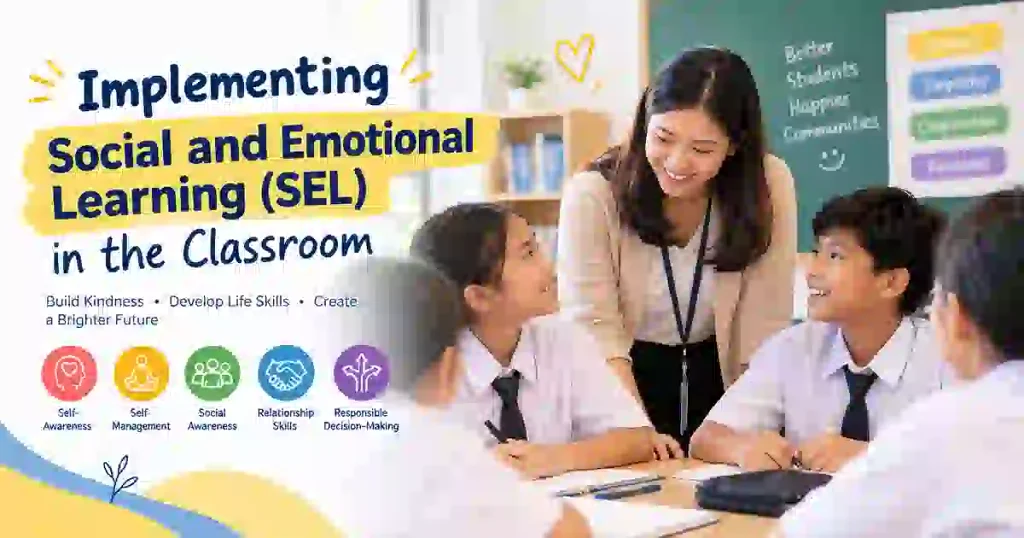
A widely used framework developed by the Collaborative for Academic, Social, and Emotional Learning (CASEL) identifies five core SEL competencies.
1. Self-Awareness
Self-awareness is the ability to recognize one’s emotions, thoughts, values, strengths, and limitations.
In the classroom, teachers can help students develop self-awareness by asking questions such as:
- How do you feel about today’s lesson?
- What part of this activity was most challenging for you?
- What are your strengths as a learner?
- What would you like to improve next time?
These reflections help students understand themselves and recognize how their emotions influence learning.
2. Self-Management
Self-management involves regulating emotions, managing stress, controlling impulses, and setting goals.
Teachers can develop this competency by introducing short breathing exercises, helping students organize their tasks, establishing predictable classroom routines, and teaching strategies for handling frustration.
For example, students may set a personal learning goal at the beginning of a lesson and reflect on their progress at the end.
3. Social Awareness
Social awareness is the ability to understand other people’s perspectives, demonstrate empathy, and appreciate differences.
Teachers can encourage social awareness through group discussions, storytelling, role-playing, and activities that invite students to consider different points of view.
Students should learn that respectful disagreement is possible and that differences in opinion do not justify insulting or excluding others.
4. Relationship Skills
Relationship skills include communicating clearly, listening actively, cooperating with others, resolving conflicts, and seeking or offering help when needed.
Teachers can strengthen these skills by organizing cooperative projects with clearly defined roles, teaching respectful discussion techniques, and guiding students through conflict resolution.
For example, when two students disagree during a group project, the teacher can help them explain their perspectives, listen to each other, and agree on a fair solution.
5. Responsible Decision-Making
Responsible decision-making involves making thoughtful choices that consider safety, ethical standards, personal goals, and the well-being of others.
Teachers can develop this competency by presenting realistic classroom scenarios and asking students to evaluate possible solutions.
Questions such as “What might happen if you choose this option?” and “How could your decision affect other people?” encourage students to think critically before acting.
How to Implement Social and Emotional Learning in the Classroom
Implementing SEL does not always require additional teaching periods or complicated learning materials. Teachers can integrate social and emotional competencies into existing classroom activities.
The following strategies provide practical starting points.
1. Begin the Lesson with an Emotional Check-In
Start the lesson by giving students a brief opportunity to identify and express how they feel.
Teachers may use an emotion chart, a simple rating scale, or a short written reflection. Students can indicate whether they feel calm, excited, worried, tired, or frustrated.
The purpose is not to force students to share personal information but to help them recognize their emotional state and prepare for learning.
Teachers should respect students’ privacy and allow them to participate in ways that feel comfortable.
2. Establish Positive Classroom Agreements
Involve students in developing classroom agreements that promote respect, responsibility, fairness, and cooperation.
Examples include:
- Listen when someone else is speaking.
- Respect different opinions.
- Use kind and appropriate language.
- Take responsibility for mistakes.
- Ask for help when needed.
- Solve disagreements without hurting others.
When students participate in creating these agreements, they can develop a stronger sense of responsibility for maintaining a positive classroom environment.
3. Integrate SEL into Group Learning Activities
Cooperative learning provides opportunities for students to practice communication, empathy, self-management, and teamwork.
Teachers can assign different responsibilities to group members, such as discussion leader, note-taker, timekeeper, and presenter.
After the activity, ask students to reflect on how they worked together, how they handled disagreements, and what they could improve in future collaborations.
This makes SEL part of the learning process rather than an isolated activity.
4. Use Reflective Questions During Learning
Reflection helps students understand both their academic progress and their emotional responses to learning challenges.
Teachers can ask questions such as:
- What did you learn from today’s activity?
- What did you do when you encountered a difficult task?
- How did you contribute to your group’s success?
- What would you do differently next time?
- How did you respond when someone disagreed with your idea?
These questions encourage students to develop self-awareness, persistence, and responsibility.
5. Model Empathy and Respectful Communication
Teachers play an important role in demonstrating the social and emotional behaviors they expect from students.
For example, teachers can listen carefully when students speak, acknowledge their feelings, provide constructive feedback, and respond calmly when problems arise.
Instead of saying, “You are careless,” a teacher might say, “I noticed that you missed several instructions. Let’s review them together and find a way to help you complete the task.”
This approach addresses behavior without labeling the student and creates an opportunity for improvement.
6. Teach Students How to Manage Conflict
Disagreements are a normal part of classroom interaction. SEL helps students learn to resolve conflicts respectfully rather than through aggression, blame, or exclusion.
Teachers can guide students through a simple process:
- Pause and calm down before responding.
- Explain the problem using respectful language.
- Listen to the other person’s perspective.
- Identify possible solutions.
- Agree on a fair next step.
- Reflect on what can be learned from the experience.
Teachers should provide additional support when conflicts involve bullying, threats, discrimination, or significant power imbalances.
7. Encourage a Growth Mindset
A growth mindset encourages students to view mistakes and challenges as opportunities to learn and improve.
Teachers can reinforce this attitude by recognizing effort, strategy, persistence, and progress rather than focusing exclusively on grades or performance.
For example, instead of saying, “You are naturally good at science,” a teacher could say, “Your experiment improved because you carefully examined the results and adjusted your method.”
This type of feedback helps students recognize the value of learning strategies and continued effort.
8. Use Literature, Stories, and Real-Life Scenarios
Stories and realistic situations provide opportunities to explore emotions, relationships, fairness, and decision-making.
After reading a story, teachers can ask students to identify how the characters feel, explain why they behave in certain ways, and suggest alternative responses.
In social studies, language lessons, science projects, and other subjects, teachers can also discuss cooperation, ethical choices, environmental responsibility, and the consequences of human actions.
These activities help students connect SEL with academic content and everyday life.
9. Provide Opportunities for Student Voice and Choice
Students can develop autonomy and responsible decision-making when teachers provide appropriate opportunities to express opinions and make choices.
For example, teachers might allow students to choose between two project formats, suggest discussion topics, or propose strategies for improving group work.
Student participation should remain consistent with learning objectives, classroom safety, and the needs of the wider class.
10. End the Lesson with Reflection
A short reflection at the end of a lesson helps students recognize what they have learned and how they interacted with others.
Students can complete prompts such as:
- One thing I learned today was…
- One emotion I experienced during learning was…
- One way I helped my classmates was…
- One thing I want to improve is…
Teachers can use these reflections to understand students’ experiences and plan appropriate follow-up activities.
Examples of Social and Emotional Learning Activities in the Classroom
The following examples illustrate how teachers can integrate SEL into different learning situations.
Example 1: Emotional Check-In Before a Lesson
Objective: Help students recognize and communicate their emotions.
Activity: At the beginning of the lesson, students select an emotion word or image that reflects how they feel. The teacher briefly explains that different emotions are normal and that students can ask for support when necessary.
SEL competencies: Self-awareness and self-management.
Expected outcome: Students become more familiar with identifying their emotions and preparing themselves for learning.
Example 2: Cooperative Problem-Solving
Objective: Develop teamwork and respectful communication.
Activity: Students work in small groups to solve a problem. Each member has a role and must contribute ideas. Afterward, the group discusses how they shared responsibilities and handled different opinions.
SEL competencies: Social awareness, relationship skills, and responsible decision-making.
Expected outcome: Students practice listening, cooperation, and constructive problem-solving.
Example 3: Role-Playing a Classroom Conflict
Objective: Teach students to resolve disagreements peacefully.
Activity: The teacher presents a scenario in which two students disagree about how to complete a group assignment. Students role-play different responses and discuss which approaches are respectful and effective.
SEL competencies: Self-management, social awareness, and relationship skills.
Expected outcome: Students gain practical experience in expressing opinions, understanding others, and identifying fair solutions.
Example 4: Personal Learning Reflection
Objective: Encourage self-awareness and continuous improvement.
Activity: At the end of a lesson, students write a short reflection about a challenge they faced, the strategy they used, and what they would like to improve.
SEL competencies: Self-awareness and self-management.
Expected outcome: Students become more aware of their learning strategies and personal development.
Example 5: Appreciation and Positive Feedback
Objective: Build a classroom culture of respect and encouragement.
Activity: Students provide specific, respectful feedback about a classmate’s contribution to a group task. The teacher models feedback that recognizes helpful actions rather than making judgments about personality.
SEL competencies: Social awareness and relationship skills.
Expected outcome: Students practice recognizing others’ contributions and communicating appreciation appropriately.
The Role of Teachers in Successful SEL Implementation
Teachers are central to creating classroom conditions that support social and emotional development. Successful SEL implementation requires more than occasional activities; it involves consistent practices and positive relationships.
Teachers can support SEL by taking the following actions.
First, build positive relationships with students. Learn about students’ interests, recognize their individual strengths, and create opportunities for them to express their concerns.
Second, demonstrate the expected behaviors. Students learn from how teachers listen, communicate, respond to mistakes, and manage difficult situations.
Third, create an inclusive learning environment. Ensure that classroom activities provide opportunities for participation and that students are treated fairly regardless of their abilities or backgrounds.
Fourth, integrate SEL into academic instruction. Connect social and emotional competencies with reading, writing, mathematics, science, arts, and collaborative projects.
Fifth, observe and reflect on student development. Pay attention to students’ participation, communication, cooperation, and responses to challenges. Use these observations to adjust teaching strategies and provide appropriate support.
Finally, collaborate with families and colleagues. When appropriate, consistent communication between teachers, families, school counselors, and other school staff can help students receive coordinated support.
How to Assess Social and Emotional Learning
Assessing SEL requires a thoughtful approach because emotions, relationships, and personal development are complex. Teachers should not assume that a single observation or questionnaire fully represents a student’s social and emotional abilities.
Instead, teachers can use several sources of information.
1. Classroom Observation
Observe how students participate in discussions, manage disagreements, respond to challenges, and collaborate with peers.
Use clear indicators related to the learning objectives, rather than making broad judgments about a student’s personality.
2. Student Self-Reflection
Invite students to reflect on their emotions, decisions, interactions, and progress. Reflection can help students recognize their strengths and identify areas for improvement.
3. Peer Feedback
Structured peer feedback can help students understand how their actions affect others. Establish clear expectations so that feedback remains constructive, respectful, and focused on observable behavior.
4. Teacher Reflection
Teachers can evaluate whether classroom routines, instructional strategies, and feedback practices support a positive learning environment.
They can also consider which students need additional opportunities, guidance, or individualized support.
SEL assessment should primarily support learning and development. It should not be used to stigmatize students, make unsupported psychological diagnoses, or reduce complex personal characteristics to a simplistic score.
Challenges in Implementing SEL and How to Address Them
Although SEL offers valuable opportunities for student development, teachers may face challenges when introducing it into daily instruction.
Limited Instructional Time
Teachers may feel that academic requirements leave little time for SEL.
Solution: Integrate short SEL practices into existing lessons, such as a two-minute emotional check-in, cooperative learning, or a brief reflection at the end of class.
Different Student Needs
Students differ in their communication styles, emotional development, experiences, and willingness to participate.
Solution: Provide flexible participation options, establish predictable routines, and avoid forcing students to disclose personal experiences publicly.
Limited Teacher Preparation
Some teachers may be unfamiliar with SEL concepts or practical implementation strategies.
Solution: Begin with a small number of achievable practices, participate in professional learning, exchange experiences with colleagues, and reflect on what works in the classroom.
Difficulty Measuring Progress
Social and emotional development may not be immediately visible or easily measured.
Solution: Use repeated observations, student reflections, and clear behavioral indicators over time. Interpret evidence carefully and consider the context in which students demonstrate their skills.
Maintaining Consistency
SEL activities may have limited impact when they occur only occasionally or conflict with the school’s everyday practices.
Solution: Align classroom expectations, teacher behavior, school policies, and student support systems around shared values such as respect, inclusion, responsibility, and well-being.
Conclusion
Implementing Social and Emotional Learning (SEL) in the classroom is an important step toward developing students who are academically capable, emotionally aware, socially responsible, and able to build positive relationships.
Through emotional check-ins, cooperative learning, reflective discussions, respectful communication, conflict resolution, and responsible decision-making, teachers can integrate SEL into everyday teaching and learning.
The process does not require teachers to transform every lesson at once. Starting with small, consistent practices can help establish a classroom culture in which students feel respected, participate actively, and learn to manage challenges constructively.
Ultimately, effective SEL implementation requires commitment, empathy, reflection, and collaboration. When social and emotional development becomes part of the classroom experience, education can support not only what students know but also how they understand themselves, relate to others, and contribute positively to society.
Frequently Asked Questions (FAQ)
1. What is Social and Emotional Learning (SEL)?
Social and Emotional Learning (SEL) is the process of developing skills to understand and manage emotions, demonstrate empathy, build positive relationships, and make responsible decisions.
2. What are the five core competencies of SEL?
The five core competencies are self-awareness, self-management, social awareness, relationship skills, and responsible decision-making.
3. Why is SEL important in the classroom?
SEL helps create a supportive learning environment and provides opportunities for students to practice emotional regulation, empathy, collaboration, conflict resolution, and responsible decision-making.
4. How can teachers implement SEL in everyday lessons?
Teachers can use emotional check-ins, cooperative learning, reflective questions, classroom agreements, role-playing, positive feedback, and end-of-lesson reflections.
5. Does SEL require a separate subject?
No. SEL can be integrated into existing subjects, classroom routines, group projects, discussions, and other learning activities. Schools may also provide dedicated activities when appropriate.
6. How can teachers assess students’ SEL development?
Teachers can use classroom observations, student self-reflections, structured peer feedback, and ongoing reflection on classroom interactions. Assessment should focus on development and support rather than labeling students.
7. What is the difference between SEL and academic learning?
Academic learning focuses on subject knowledge and academic skills, while SEL focuses on emotional awareness, self-management, social understanding, relationships, and responsible choices. Both can complement each other in the learning process.
8. Can SEL be implemented in elementary and secondary schools?
Yes. SEL can be adapted for elementary, junior secondary, and senior secondary students. Activities should reflect students’ developmental stages, learning needs, and classroom contexts.
9. What role do teachers play in SEL implementation?
Teachers model respectful behavior, build positive relationships, establish inclusive classroom routines, integrate SEL into instruction, and provide appropriate guidance when students encounter social or emotional challenges.
10. What is the first step in implementing SEL in the classroom?
A practical first step is to establish a supportive classroom environment and introduce a simple activity, such as an emotional check-in or a shared classroom agreement. Teachers can then gradually incorporate other SEL strategies into daily learning.
References and Further Reading
- Collaborative for Academic, Social, and Emotional Learning (CASEL). What Is the CASEL Framework? https://casel.org/fundamentals-of-sel/what-is-the-casel-framework/
- CASEL. Fundamentals of Social and Emotional Learning. https://casel.org/fundamentals-of-sel/
- Durlak, J. A., Weissberg, R. P., Dymnicki, A. B., Taylor, R. D., & Schellinger, K. B. (2011). The impact of enhancing students’ social and emotional learning: A meta-analysis of school-based universal interventions. Child Development, 82(1), 405–432. https://doi.org/10.1111/j.1467-8624.2010.01564.x
- Mahoney, J. L., Durlak, J. A., & Weissberg, R. P. (2018). An update on social and emotional learning outcome research. Phi Delta Kappan, 100(4), 18–23. https://doi.org/10.1177/0031721718815668
This article is intended to support teachers in understanding and applying Social and Emotional Learning in classroom practice. Activities should be adapted to the school’s educational context and students’ developmental needs.